

AI is here to stay


Artificial intelligence is not a temporary project. It is here to stay. At the Berlin conference “AI in Photonics—Adding Value in Laser Manufacturing Technology,” experts advised companies to adapt their strategies to the new reality.
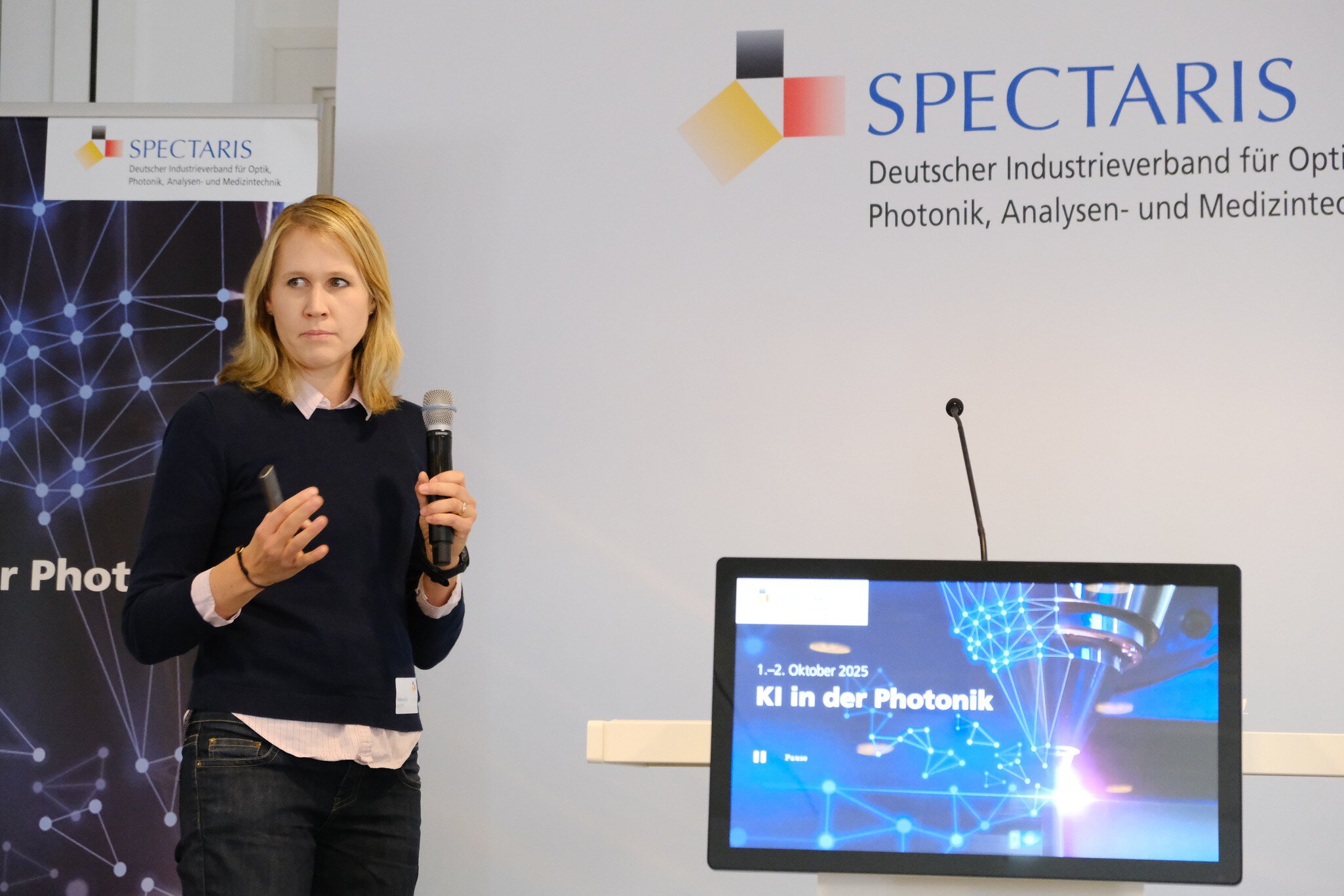
"It's not going away. AI is not an IT project with a beginning, milestones, and an end. We can say goodbye to that. AI is a lifelong strategic task for companies," warned Dr. Vanessa Just, board member of the German AI Association and founder of the AI start-up juS.TECH, at the Berlin conference hosted by the SPECTARIS association, Fraunhofer ILT, and the German Association for IT SMEs (BITMi) in early October 2025. "Every company must answer for itself what this technology can and should do for its business model," explained Just. But for her, the question is much broader: "How do we as Europe, as Germany, as companies, and as a society want to use AI and leverage it for our benefit? The aim is to anchor this novel toolkit in everyday business and private life in a beneficial way. And she sees this not as an option, but as a necessity: "AI is a question of corporate orientation—shaping the present and ensuring the future viability of companies." Used correctly, AI solutions can automate and streamline processes outside of core activities, allowing skilled workers to pursue their actual specialization and, with the support of AI, exert greater leverage.
At the same time, Just reminded us that it is not technology, but people and processes that determine the success of AI implementation. She advised: "Bring along the people who are enthusiastic about AI. But don't forget those with reservations and fears, because they too remain an important resource for your companies as bearers of know-how."
Gradual implementation
Michael Berndt advises medium-sized companies on how to integrate AI into their structures as a coach and consultant. The founder of KI-Klarheit.de explained in Berlin what is important when it comes to implementation. It starts with clear communication—although this is easier said than done: "Clear communication first requires clarity about your own goals when introducing AI. But none of us really knows what to expect," he said. He therefore advises companies to engage in open dialogue and use low-threshold formats in which interested parties can gather ideas without hesitation. They can collect pain points from their everyday work or express reservations. Those who get involved here can become AI ambassadors and multipliers during the introduction.
Before the actual launch, it is also essential to conduct a thorough data inventory, including an analysis of the value of the respective data from the various departments for working with AI—and where preparations such as anonymization or randomization need to be made with regard to sensitive data—or which AI processes should run in the cloud and which on the internal IT infrastructure. Even though the IT department must be involved here, AI implementation is by no means a task that it can solve on its own. "It's about business understanding, a feel for content, knowledge transfer, and business processes, and only then does implementation at the IT level come into play," he clarified.
In AI models that can write software code, this leads to a doubling of performance every 4 to 5 months. His warning: "Everything is code. What you talked about at this conference is code. Word, Excel, PowerPoint, ERP or CRM solutions—everything is code. And soon, all of this will run almost fully automatically. The work of developers will change just as dramatically as technological progress." Experts often remain unclear about how AI increases efficiency, but corresponding tools are now even being used to detect gravitational waves, and AI is also ensuring ever-higher energy yields in fusion experiments. The whole thing is a marathon—and even there, training begins with warming up and starting to jog.
Deep rendering—synthetically generating missing image data
When using AI, for example in image processing systems to optimize production processes, many companies encounter the problem that there is a lack of usable image data for the initial training of AI tools. The more specific the applications, the scarcer the supply of pre-trained models. Many presentations at the Berlin conference addressed this problem. For photonic applications, manual labeling of image data is the order of the day, which is time-consuming and incurs high personnel costs. In addition, AI models must be insensitive to environmental influences—light, contamination, or wear—as well as to changing process conditions. The more usable image data with varying conditions is incorporated into the training, the more robust the models will be. Dr. Sven Wanner, managing director of Artificial Pixels GmbH in Heidelberg, presented a solution for this. His company uses AI to generate suitable images for training. Synthetically generated images often have the problem that, although they are hardly distinguishable from the original to the human eye, the columns of numbers behind them are too different for the evaluating software.
The Artificial Pixels approach: The company gradually destroys real training images with noise and lets generative AI reconstruct images from them. However, it incorporates many deviations and variances without fundamentally altering the image content and with numerical values very similar to those of the original images. This makes it possible to generate almost any number of slightly varying data sets for training from just a few input images. This deep rendering is cost-effective and provides users with large amounts of data that are similar enough to the originals to enable AI models to be used in changing production environments. In this case, AI learns from AI. The bottom line of the conference: AI already has a major impact on value creation processes today—and it is here to stay.