

Award-winning photonic innovations


The stage is set for the winners of the Laser World of Photonics Innovation Awards 2025, their outstanding innovations, and for those teams that made it onto the shortlist of nominees.
Laser World of Photonics, World of Quantum, automatica, and World of Photonics Congress 2025 took place in parallel in June at the Munich Exhibition Grounds. A superlative event that connects players, brings communities together—and rushes breathlessly from highlight to highlight!
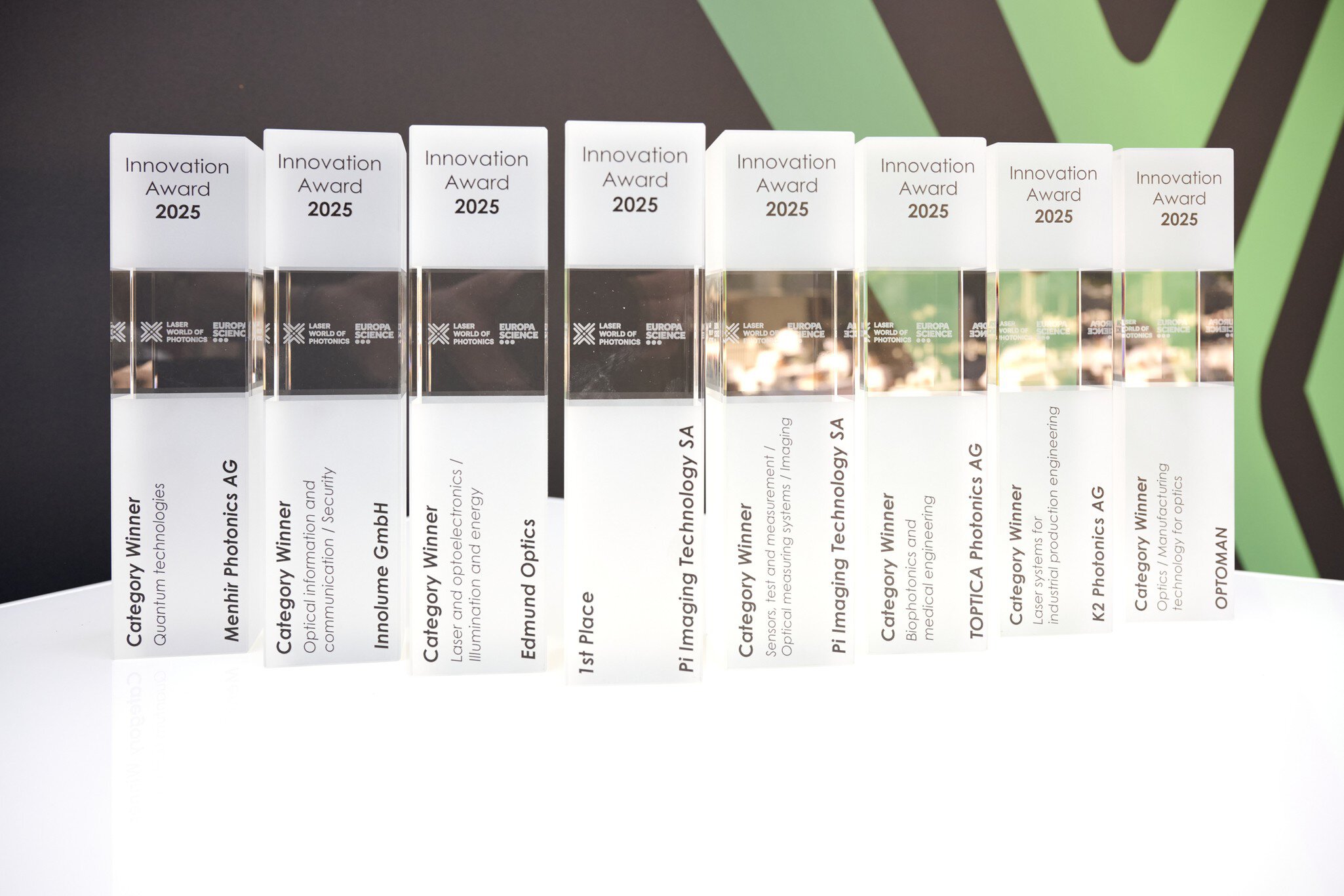
The winners in the seven categories of the Innovation Award 2025 only had a brief moment in the spotlight during the trade fair. However, they convinced the 11-member jury that their award-winning solutions could advance photonics in the long term. The same applies to the teams on the shortlist and, of course, the overall winner of the €5,000 prize: Pi Imaging Technology SA from Lausanne, Switzerland. In the current PHOTONICS interview, CEO and co-founder Dr. Michel Antolovic explains the technological approach, features, and areas of application of the award-winning SPAD Alpha megapixel single-photon camera. He gives insights beyond his own company to current trends and developments in sensor technology. As the overall winner, his company naturally also prevailed in the category in which it competed. Also nominated were ficonTEC Service with a novel solution for double-sided electro-optical series testing of wafers and, in particular, photonic integrated circuits (PICs), as well as Hamamatsu Photonics Germany with a fingertip-sized UV mini spectrometer. It splits UV light in the spectrum from 190 to 440 nm into individual wavelengths, whose light intensity it records in high resolution. The miniaturized and cost-effective instrument is among other use-cases, intended for use in environmental measuring devices.
Categories cover a wide range of applications
In addition to sensor and measurement technology, the Innovation Award covers six other categories from the broad spectrum of photonics applications. Its two sponsors—Laser World of Photonics and Europa Science, publisher of the magazines Electro Optics, Laser Systems/Europe, Fibre Systems, and Imaging and Machine Vision Europe—have established a benchmark that documents the dynamic technological development of the industry every two years and honors outstanding new developments. These include an extremely robust optical mirror from Edmund Optics, the winner in the field of lasers, optoelectronics, lighting, and energy. Robust optics are indispensable due to the rapidly increasing pulse energies of ultrashort pulse (USP) lasers—for many applications, the laser damage threshold (LDT) of the optics is now considered a bottleneck.
This is where the award-winning PeakPower High LDT Low GDD Ultrafast Mirror comes in. It combines high reflectivity (>99.5%) with a group delay dispersion (GDD) value of nearly zero and a laser damage threshold of over 0.75 J/cm², which is unprecedented for mirrors with these properties when exposed to UKP lasers with a wavelength of 920 nm and a pulse duration of 25 femtoseconds. Until now, it was generally the case that high LDT came at the expense of reflectivity and GDD—or vice versa. Edmund Optics has resolved this conflict through a clever combination of optimized coating materials and processes. Nevertheless, it must have been difficult for the jury to choose the category winner. The TruMicro 9010 from TRUMPF Laser- und Systemtechnik is also considered a major success: it is the first industrially usable UKP laser with an average power in the kW range. Its peak power is even 10 GW (@100 kHz repetition rate). These values, combined with high precision and reliability, will enable efficient scaling of existing—and many new UKP applications.
Special contributions to biophotonics and medical technology as well as quantum technology
TOPTICA Photonics made it onto the shortlist in two categories. In biophotonics and medical technology, they won the category with their FemtoFiber ultra FD for the wavelength ranges of 780, 920, and 1050 nm. What makes this femtosecond laser for two-photon microscopy so special is the direct transmission of fs-pulses from the laser source to the microscope via an optical fiber, which eliminates free space paths and with them the need for mirror alignment and power measurement in the beam path. This paves the way for new user-friendly microscope designs with increased laser safety. The groundbreaking concept prevailed over solutions from Futonics Laser and LaserAtWork. The latter submitted its “Hummingbird,” a miniaturized 1030 nm fs laser oscillator that delivers >1 W average power and pulses of <200 fs@50 MHz. Including cooling and electronics, it measures only 70 x 49 x 28 mm, which enables integration into compact devices for applications such as optogenetics or 2-photon imaging, or as a robust seed source for amplifiers. The third innovation on the shortlist was a 2-µm thulium fiber laser from Futonics Laser, which delivers 1,000 W in quasi-continuous wave mode and 200 W in continuous wave mode and features a patented coupling system. It is designed for minimally invasive lithotripsy—the fragmentation of kidney, gallbladder, or bladder stones.
In the quantum technology category, TOPTICA's Laser CTL 780 with wide mode-hopping-free tuning from 750 to 790 nm made it onto the shortlist, as did the attoCMC from attocube systems AG. The latter is a compact solution for cryogenic cooling in the field of photonic quantum technologies. The plug-and-play system minimizes power consumption and significantly reduces infrastructure costs, making it ideal for applications in data centers and compact, market-ready quantum systems. The category winner is Menhir Photonics AG. Its MENHIR-1030 is the first industrial-grade 1 GHz fs laser, impressive with extremely low noise, maximum stability, and maintenance-free 24/7 operation. It is used for tasks with the highest precision requirements, whether it be the generation of high-flux single and entangled photons in quantum technologies or ultra-high peak powers with activatable GHz burst mode in material processing.
Strong momentum for industrial laser material processing
Solutions that provide strong impetus for industrial laser processing have also prevailed in other categories. OPTOMAN won the category of optics and manufacturing technology for optics with non-degrading UV optics that enable significantly longer service life and stable performance in high-power UV laser applications. The mirrors are optimized for ultrashort (fs/ps) pulses at UV wavelengths (257/343 nm). While degradation processes often begin after 1,000 hours in conventional UV optics in this parameter range, the award-winning mirrors from OPTOMAN can withstand over 10,000 hours of high-power UV exposure. Midel Photonics also made the shortlist with a fully reflective beam shaping system based on microstructured mirrors for beam shaping, splitting, and focusing. This approach ensures more uniform energy distribution and reduced energy losses in laser processes in macro and micro machining as well as in the life sciences. Both contribute to quality improvement and cost reduction.
These goals are, of course, also pursued by the nominees in the category of laser systems for industrial manufacturing technology. The winner here was K2 Photonics AG. With ASOPS, the company introduced a compact 60 MHz fs laser that generates two output beams. It differs little from a single laser, but parallelizes the beam shaping of the two beams, with almost identical repetition rates during operation but a controllable, stable difference. The approach has the potential to take laser measurement applications such as semiconductor wafer inspection, layer thickness analysis, adhesion testing, and other complex material characterization to a new level. EKSPLA also made it onto the shortlist with an fs laser. This is a maintenance-free industrial 50 W fs laser with water-free cooling. Thanks to the innovative Direct Refrigerant Cooling (DRC) system, it allows maintenance-free continuous operation, having demonstrated a power stability of <0.5% over 90,000 hours of use. Its features also include harmonics (515 nm, 343 nm), pulse-on-demand, and GHz burst for demanding micro-machining tasks. The third company on the shortlist of nominees was ROBUST AO GmbH. With a deformable mirror that oscillates at up to 3500 Hz, their Zwobbel IR-HP solution enables real-time axial beam shaping in high-power lasers up to 20 kW. The approach adapts the Rayleigh length, spot size, and intensity profile in terms of dynamically controllable energy density, thereby ensuring higher speed (+90%), quality, and efficiency in laser cutting, welding, and structuring.
Far from fully developed: optical information, communication, and security
Photonic solutions continue to drive innovation in information and communication technology (ICT). Innolume won the award in this field with its “O-Band quantum dot semiconductor optical amplifier” (QD SOA). The compact, electrically pumped semiconductor device offers performance comparable to erbium-doped fiber amplifiers (EDFA) and enables the simultaneous amplification of multiple modulated laser lines or very high output power when operating at a single wavelength. As uncooled, energy-efficient SOA, the device is designed for data communication, AI connectivity, terrestrial free space optical (FSO) connections, FMCW LiDAR, or optical switching, according to Innolume. Two other companies, piezosystem jena and Zerothird, were also nominated in this category. The team from Jena presented its piezo-driven, two-axis tilt tables PSH 20/2 and PSH 35/2, a technology originally developed for optical intersatellite communication. Their tilt of up to ±22 mrad and resolution of 1.0 µrad can be controlled in a closed control loop and a resonance of up to 2 kHz. The space-qualified technology offers maximum speed, precision, and low power consumption even under extreme conditions. This makes it interesting for beam control in laser systems, photonic applications, and aerospace.
Finally, Zerothird has also made a highly innovative contribution to the ITC industry—or will do so in the future. Like all solutions presented in the Innovation Award, their entanglement-based QKD system (eQKD system) is at the very beginning of its product life cycle.
Zerothird uses polarization-entangled photon pairs and superconducting nanowire detectors for secure quantum key distribution in accordance with the BBM92 protocol. The industrial design includes a photonic layer that eliminates the need for optical realignment, thereby optimizing reliability and stability in real-world operation. The eQKD systems support short- and long-distance connections of up to 350 km and can also be used in networks with star topology. The goal is to secure critical communications infrastructures.
Further information on the Laser World of Photonics Innovation Award 2025 can be found here.