

“AI leads to faster results in many applications”


AI is developing enormous momentum and has a growing influence on value creation in photonics—from research and development to manufacturing. Can smaller medium-sized companies and their customers also benefit from this? In an interview with PHOTONICS, Thibault Bautze-Scherff, sales manager at Blackbird Robotersysteme GmbH, talks about the opportunities, risks, and technological potential.
Mr. Bautze-Scherff, what access do you have to artificial intelligence (AI) in your role as sales manager and personally?
Thibault Bautze-Scherff: AI is definitely present in sales and sales processes today, for example for efficient product data and customer relationship management. In many cases, however, these are just nice gimmicks. More and more tools for automated, AI-based lead generation are also coming onto the market. Instead of conventional acquisition, they systematically screen companies to identify potential customers, identify contact persons, and write to them immediately. This may work in some industries. However, I am rather skeptical when it comes to photonics: Here, specialists work on both the customer and supplier sides who, with their wide-ranging expertise, cannot be replaced by AI anytime soon. The task of persuading, explaining, and finding solutions together will remain with us humans in the medium term. Specific industry expertise is a competitive advantage over large platform providers, which are gaining market share in more and more industries. On a personal note about AI: I wrote my thesis in 2008 at Precitec on AI-based data processing for controlling laser welding processes. It was about error detection and the control of parameters such as laser power. At that time, it wasn't called AI, but rather machine learning. I then spent several years researching this field in industry, partly as part of European funding projects. The topic of data fusion was already very important back then.
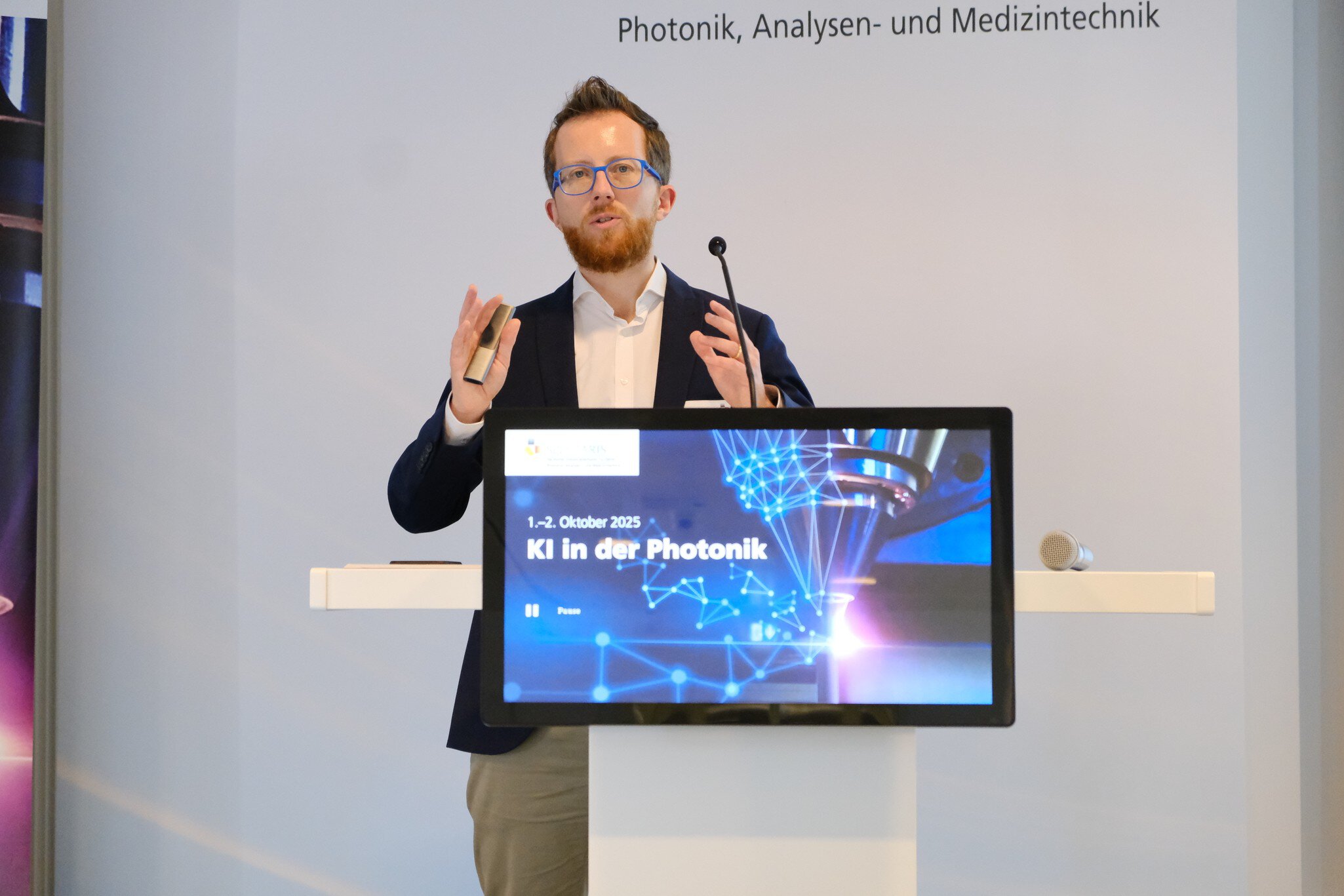
Are your customers open to the use of AI solutions?
Bautze-Scherff: We are conducting intensive research into AI solutions and equipping our systems with interfaces for AI tools to evaluate sensor data. There is a great deal of openness to the use of AI. This is because it accelerates the learning curves for laser joining and simplifies the implementation of error-free processes. However, acceptance ends when AI makes decisions and adjusts processes. This is because our customers are primarily from the automotive sector and in many cases work with safety-critical and high-quality components. Standards must be adhered to. AI is a black box. There are doubts as to whether it might not make mistakes. Especially with simpler components, many customers also see no benefit in using AI for process control. On the other hand, there is a high level of acceptance when it comes to welding fuel cells or batteries. Here, there is very close sensory monitoring to rule out defective weld seams. AI does not yet control the processes as a rule, but it helps to evaluate the sensor data and supports inline image processing.
What does AI do in laser welding processes, and what are the most important areas of application?
Bautze-Scherff: When I look to the future, I see AI as a very important tool for optimizing processes. This is because the quality of laser welding processes is influenced by an extremely large number of parameters: laser power, air management, clamping technology, and the intensity distribution of the laser on the component, which can be controlled with increasing flexibility. In the past, it was a spot. Today, there are four-point optics and refractive optical elements that can apply any geometry to the component. In some cases, flexible patterns can also be applied to the component using numerous superimposed, coherent beams through phase shifting. AI can help identify optimal settings in these increasingly complex parameter spaces and minimize the number of time-consuming and material-intensive trials. In conjunction with the available knowledge about physical relationships, AI can greatly accelerate process optimization. This is especially true when I think about the increasing variety of materials. I also see great potential for the use of AI in service, for example in the remote detection and troubleshooting of malfunctions. The same applies to predictive maintenance.
In e-mobility and the hydrogen economy, there are many welding applications with maximum quality requirements. What AI-supported strategies are available to meet these requirements?
Bautze-Scherff: One of our specialties is battery module production. Today, we set up the welding processes to be stable. There is no need for software-based AI to think along and optimize them. However, it will play a central role in quality monitoring, particularly in the evaluation of OCT (optical coherence tomography) measurement data as a supplement to micrographs, which we use to determine the depth of weld seams. In the future, AI will be able to derive not only mechanical properties but also electrical properties such as the conductivity or resistance of joints from OCT data; there are already initial solutions on the market that can do this. Looking ahead, I hope that the use of self-learning systems will mean that we will have to evaluate fewer and fewer micrographs because AI will be able to derive the information directly from the process data. That would be a leap forward in efficiency in quality management. In the hydrogen economy, our primary concern is the joining of ultra-thin bipolar plates. This involves thousands of weld seams that must be applied quickly and with absolute precision. This is not so easy, as the plates are so thin and the processes so fast. There is only a small process window. And even the smallest deviations often lead to total loss. AI can help with heat management, for example, by optimizing the scanning strategy to minimize the energy input from the laser.
Laser welding processes depend on the meticulously controlled interaction of scanners, lasers, path planning, and continuous sensory process control. Will AI make it possible in the future to translate this complex interaction into autonomous welding processes?
Bautze-Scherff: That is the vision. At the AI conference in Berlin, we heard that, for example, very precise time stamps are important—and that any latency that occurs on the way to the cloud must be taken into account very precisely. If that is not guaranteed, the whole thing is useless. Especially with regard to concepts for merging different sensors, the harmonization of data is becoming a fundamental prerequisite. But I do believe that in the future, AI will independently carry out robot path planning, evaluate sensor data, and, based on this, will eventually be able to autonomously perform entire robot-assisted laser joining processes. Whether this will be the case in 20 or 50 years is difficult to say. But I am quite sure that it will happen. However, it will depend on whether AI is more expensive than humans in the specific application. The entire field of clamping technology, for example, is so complex that I believe humans will have an advantage over robots for a very long time to come.
High-performance IT infrastructure is needed to link production and sensor data efficiently and accurately. At the same time, AI is supposed to turn everyone into a programmer. Where do small and medium-sized enterprises fit into this new world?
Bautze-Scherff: Intelligent isolated solutions. Small and medium-sized enterprises are unlikely to develop solutions that compete with providers of large language models, but will instead develop application-oriented, industry-specific AI tools. In the field of laser joining, for example, such a solution could be linked to the available physical knowledge to monitor the interaction of lasers, scanners, optics, and materials and, in the future, also intervene in a regulatory manner. These are niche applications that would require a great deal of expertise, which makes them unattractive to global players. The large providers make generic solutions, on the basis of which and with whose cloud infrastructure the small ones will implement their specific AI tools. Infrastructure is the be-all and end-all for effective AI deployment. This is true even in terms of actual data fusion alone. Plant, sensor, and process data should flow together in the cloud so that they are available across locations. This requires users to develop appropriate strategies for handling data and ensuring its security.
US corporations and heavily state-subsidized providers from China are pushing into the AI market with big plans. What strengths do German and European providers have in this highly time-critical global competition?
Bautze-Scherff: In addition to the competition between humans and AI, there is also global competition. In this arena, others obviously have better starting conditions and fewer regulatory hurdles. We live in a free market economy. What works and is cheap gets bought. However, we in Germany and Europe have process and industry expertise that still sets us apart. When it comes to sophisticated solutions for complex tasks, we are way ahead of others. Even in an AI-dominated world, there will still be medium-sized hidden champions whose success is based on superior solutions.
And where do you see weaknesses?
Bautze-Scherff: Asian countries are superior in the mass production of high-tech products, whether chips, batteries, or LEDs. Our strengths lie more in specialized solutions. Elsewhere, companies are not as heavily regulated, access to venture capital is easier, and they serve much larger domestic markets. But this is nothing new. We have been able to compensate for this so far.
How do you imagine the manufacturing environments in which your laser welding robots operate today in ten, twenty, or even 50 years?
Bautze-Scherff: The degree of automation is increasing rapidly. In China, there are already these dark factories where, in principle, the lights are left off because only machines that do not need daylight are still working. Vehicle manufacturing in Europe is already highly automated. AI will initially become increasingly important in service, but will gradually reach break-even point in competition with human skilled workers in more and more applications. We will see AI-supported autonomous driving and automated delivery services that process orders without human intervention. In laser welding, we will see solutions in which humans no longer play a role, but above a certain level of complexity, humans will remain superior for a long time to come thanks to their cognitive, sensory, and motor flexibility. We have only limited influence on development. But I think that in a few hundred years, our time will be seen as a turning point.